CLM ADspinup

dou

Dou Jiahui
New Member
I created a custom 0.1° regional case for China(CESM2.2.0). The model was successfully configured and runs normally after replacing the default input datasets with China-specific atmospheric forcing data, PCT_NAT_PFT data, and soil datasets.

I am currently in the Accelerated Decomposition (AD) spinup phase and have completed 53 years of accelerated spinup.

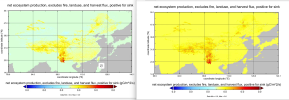
In the attached figures, the left panel shows the NEP (Net Ecosystem Production) spatial pattern during the early stage of AD spinup (approximately years 20–30). At this stage, the spatial distribution appears reasonable and generally reflects the expected NEP pattern across China.

The right panel shows the NEP spatial pattern during the later stage of AD spinup (approximately years 40–50), after the deep soil carbon pools have become relatively stable. At this point, the NEP distribution appears much less realistic. I noticed that regions that originally had relatively low NEP values (the cyan-colored areas in the early-stage figure) show substantially higher NEP values later in the spinup. In contrast, the southeastern region, which originally had the highest NEP values, does not increase as rapidly as other regions, resulting in a much flatter and less realistic spatial pattern.

My questions are:

  1. Is this behavior expected during the AD spinup phase of CLM5/CESM?
  2. Can the stabilization of deep soil carbon pools and the accelerated decomposition mechanism alter the spatial pattern of NEP in this way?
  3. Should I continue running the AD spinup, or does this behavior suggest a potential issue with my setup or input data?
  4. Is it normal for the NEP spatial pattern during the late AD spinup phase to deviate substantially from the expected present-day pattern? Does the realistic spatial pattern only recover after switching to the normal (non-accelerated) spinup phase? If so, approximately how many years of normal spinup are typically required before the model reaches a realistic state? Since my primary interests are vegetation (especially forest) NEP, as well as sensible heat flux, latent heat flux, and albedo, what would be the minimum recommended duration of normal spinup before beginning the actual simulation and analysis?
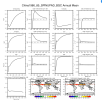
I have also attached the SpinupStability diagnostic figure generated after 53 years of AD spinup for reference.

Any suggestions or insights would be greatly appreciated.
 

Attachments

  • compare30_40.png
    compare30_40.png
    519.4 KB · Views: 10
  • ADspinup.png
    ADspinup.png
    193.4 KB · Views: 11

slevis

Moderator
Staff member
I will link another thread discussing the spin-up process, in case you wish to have a conversation with the user who opened that thread:
 
Vote Upvote 0 Downvote

dou

Dou Jiahui
New Member
I will link another thread discussing the spin-up process, in case you wish to have a conversation with the user who opened that thread:
Thank you for sharing this related thread — it is very helpful. I will take a look at the discussion there.
 
Vote Upvote 0 Downvote

dou

Dou Jiahui
New Member
Hello, I have one more question: Section 1.5.5 of the user guide states that to achieve a steady state for the clm5.0-BGC model, arbitrary initial conditions can be used to start AD spinup. Can arbitrary initial file here be the SP steady-state finidat file provided by CESM?
 
Vote Upvote 0 Downvote

slevis

Moderator
Staff member
In the user's guide the term "arbitrary initial conditions" refers to setting finidat = ' ' which uses initial values that are hardwired in the code.
You could also try the file that you have in mind because, assuming it works, then you will start from relatively spun up biogeophysics.
 
Vote Upvote 0 Downvote

dou

Dou Jiahui
New Member
In the user's guide the term "arbitrary initial conditions" refers to setting finidat = ' ' which uses initial values that are hardwired in the code.
You could also try the file that you have in mind because, assuming it works, then you will start from relatively spun up biogeophysics.
I understand. Thank you for your explanation.
Since I would like to simulate the region covering 15–55°N and 70–140°E from 1980 onward, I selected clmi.BHIST.2000-01-01.0.9x1.25_gx1v7_simyr1979_c200806.nc as my finidat file. However, this file represents only a satellite phenology (SP) equilibrium state rather than a carbon–nitrogen equilibrium state, so I used it to perform an accelerated decomposition (AD) spinup, which has been running successfully.
However, I am uncertain about how to determine whether the spinup has reached equilibrium. According to Section 2.21 of the CLM Technical Note, carbon and nitrogen pools generally require much longer to equilibrate in high-latitude and high-elevation regions. Since my study domain includes the Tibetan Plateau, I noticed from previous discussions on this forum that the non-equilibrium area threshold used in SpinupStability.ncl may need to be adjusted for regional simulations.
My question is whether it would be reasonable to relax the default criterion of the non-equilibrium 3%, and if so, how much relaxation would generally be considered appropriate for a regional simulation such as mine?
 
Vote Upvote 0 Downvote

slevis

Moderator
Staff member
I do not have experience with that. See if you can ask for feedback from scientists who relaxed the 3% threshold in their studies. Ultimately though you will have to decide what to do, because the answer may depend on your study. For some applications you may not need fully spun up biogeochemistry (e.g. focusing on biogeophysical variables or even LAI), while for others you may prefer it fully spun up (e.g. focusing on nitrogen and related variables).
 
Vote Upvote 0 Downvote

dou

Dou Jiahui
New Member
I do not have experience with that. See if you can ask for feedback from scientists who relaxed the 3% threshold in their studies. Ultimately though you will have to decide what to do, because the answer may depend on your study. For some applications you may not need fully spun up biogeochemistry (e.g. focusing on biogeophysical variables or even LAI), while for others you may prefer it fully spun up (e.g. focusing on nitrogen and related variables).
Thank you for your explanation. Based on your previous reply, I have one more question.
Would your recommendation be different if the primary objective is to obtain reliable GPP, NPP, and NEP rather than a fully equilibrated carbon–nitrogen state?
If so, I have a related question about the atmospheric forcing used during BGC AD spinup.
My simulations are designed to begin in 1980. For a BGC AD spinup intended to initialize simulations starting around 1980, would you recommend using the meteorological forcing employed in the standard I1850 BGC spinup protocol (e.g., early-20th-century forcing), or using meteorological forcing representative of the target simulation period (e.g., repeated forcing around 1980)?
The reason I ask is that I am initializing the BGC AD spinup from an SP equilibrium finidat rather than a BGC-equilibrated initial condition. Therefore, I am not sure whether the subsequent BGC AD spinup should use meteorological forcing representative of the target simulation period, or instead follow the standard forcing used in the I1850 BGC spinup protocol.
 
Vote Upvote 0 Downvote

slevis

Moderator
Staff member
Community members wishing to brainstorm with you on the methods of your study are welcome to join this thread.

Otherwise I suggest that you start some actual simulations, to begin getting a feel for how the model behaves. The answers to such questions are rarely clearcut. My role in these Forums is to help with technical difficulties rather than to brainstorm scientific methods. Sorry about that.
 
  • Like
Reactions: dou
Vote Upvote 0 Downvote
Back
Top