
We're running a circumpolar MOM6-SIS2 Southern Ocean regional config with a single northern boundary at 37°S. We've seen some odd behaviour at the open boundary when we increase DT_THERM (tracer timestep). When DT_THERM is increased above a certain threshold, the meridional transport at the boundary has a step change to incorrect values that are not what we expect from the boundary forcing.
This plot shows the deep/abyssal transport in density space, integrated zonally, at the northernmost latitude closest to the boundary, averaged over the first year of the run. The cases with DT_THERM <= 1800 have northward bottom water transport as expected, but the case with DT_THERM = 3600 has southward abyssal transport instead. As the run continues in the large DT_THERM case, the ACC dissipates and the cross-boundary transport becomes even more incorrect.
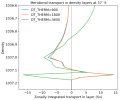
In our 1/10° config (shown here), we find the behaviour is good for values of DT_THERM <= 1800, and bad for values of DT_THERM >= 3600. In our 1/20° config, we find the behaviour is good for values of DT_THERM <= 1200, and bad for values of DT_THERM >= 1800.
I see that this behaviour has also been found in this NWA12 simulation ("Per Andrew Ross: To summarize, NWA12 behaves normally with DT_THERM = 1200 or 1800. If I try to increase DT_THERM to 3600, however, the Gulf Stream rapidly dissipates with a bizarre wave traveling to the south, and then reestablishes as a very weak current that doesn't separate at all.")
Does anyone know what the explanation for this critical dependence on DT_THERM is? And is there an a priori way to determine what a suitable value of DT_THERM is for regional configs rather than trial and error?
This plot shows the deep/abyssal transport in density space, integrated zonally, at the northernmost latitude closest to the boundary, averaged over the first year of the run. The cases with DT_THERM <= 1800 have northward bottom water transport as expected, but the case with DT_THERM = 3600 has southward abyssal transport instead. As the run continues in the large DT_THERM case, the ACC dissipates and the cross-boundary transport becomes even more incorrect.
In our 1/10° config (shown here), we find the behaviour is good for values of DT_THERM <= 1800, and bad for values of DT_THERM >= 3600. In our 1/20° config, we find the behaviour is good for values of DT_THERM <= 1200, and bad for values of DT_THERM >= 1800.
I see that this behaviour has also been found in this NWA12 simulation ("Per Andrew Ross: To summarize, NWA12 behaves normally with DT_THERM = 1200 or 1800. If I try to increase DT_THERM to 3600, however, the Gulf Stream rapidly dissipates with a bizarre wave traveling to the south, and then reestablishes as a very weak current that doesn't separate at all.")
Does anyone know what the explanation for this critical dependence on DT_THERM is? And is there an a priori way to determine what a suitable value of DT_THERM is for regional configs rather than trial and error?
