Scheduled Downtime
On Tuesday 24 October 2023 @ 5pm MT the forums will be in read only mode in preparation for the downtime. On Wednesday 25 October 2023 @ 5am MT, this website will be down for maintenance and expected to return online later in the morning.
Normal Operations
The forums are back online with normal operations. If you notice any issues or errors related to the forums, please reach out to help@ucar.edu

Questions on restarting from AD spinup, rpointer files, and MOSART in CTSM (5.3.075)

pengzhou

peng zhou
New Member
Dear CESM scientists,

Hello! I have a few questions about my simulations, many thanks in advance for your help.

I’m running the latest CTSM and have completed the AD (accelerated decomposition) spinup with compset I2000Clm60Bgc and resolution f19_g16. I’m now preparing to start the regular (non-AD) run. In user_nl_clm, I plan to set: finidat = "/.../....clm2.r....", Do I also need to set or provide corresponding cpl.r and datm.r files for this regular run?

I’ve noticed that in the new CTSM, the AD spinup no longer produces rpointer.drv; instead I see rpointer.cpl.*, rpointer.lnd.*, and rpointer.atm.*. Should all three rpointer files be copied into the new case as well?

For a study focused on GPP using prescribed atmosphere (DATM) with I2000Clm60Bgc, is it acceptable to turn off MOSART (MOSART_MODE=NULL)? If I simulate crops, should MOSART also be turned off?

Finally, after completing the spin-up, do I need to run the transient simulation multiple times to reach equilibrium, or is a single run sufficient?

Thank you very much for your guidance!
Best regards,
Peng
 

oleson

Keith Oleson
CSEG and Liaisons
Staff member
No, just the finidat will work fine.
You can turn off MOSART if you aren't interested in river discharge into the ocean. It doesn't feed back into any other components in an I-case.
A single transient run is sufficient in an I-case.
 

pengzhou

peng zhou
New Member
No, just the finidat will work fine.
You can turn off MOSART if you aren't interested in river discharge into the ocean. It doesn't feed back into any other components in an I-case.
A single transient run is sufficient in an I-case.
Thank you very much for your quick and helpful reply—it was extremely useful!
I have two brief follow-up questions:
  1. In the new CTSM, the AD spinup no longer produces rpointer.drv, but instead I see rpointer.cpl.*, rpointer.lnd.*, and rpointer.atm.*. When starting the regular (non-AD) run from the AD state, do I need to copy all three of these rpointer files into the new case?
  2. My AD spinup has run for 390 years. Before beginning the transient simulation, how many years of regular (non-AD) spinup would you recommend (e.g., 650 years, or shorter/longer)? My study focuses on GPP in an I-case using prescribed atmosphere (DATM).
Many thanks again for your guidance!
Best regards,
Peng
 

oleson

Keith Oleson
CSEG and Liaisons
Staff member
1. If you are just specifying finidat in a startup post-AD run, then you wouldn't need to copy the rpointer files.
2. GPP should come into equiiibrium pretty quickly (< 50 years). SOM will take much longer. You can use the spinup scripts in tools/contrib to plot the different variables and judge whether the simulation is spunup. See also: 1.5.5. Spinup of CLM5.0-BGC-Crop — ctsm release-clm5.0 documentation for spinup information.
 

pengzhou

peng zhou
New Member
1. If you are just specifying finidat in a startup post-AD run, then you wouldn't need to copy the rpointer files.
2. GPP should come into equiiibrium pretty quickly (< 50 years). SOM will take much longer. You can use the spinup scripts in tools/contrib to plot the different variables and judge whether the simulation is spunup. See also: 1.5.5. Spinup of CLM5.0-BGC-Crop — ctsm release-clm5.0 documentation for spinup information.
Many thanks again for your prompt and helpful reply—it’s been extremely valuable.
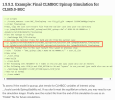
I wanted to double-check one point because I had previously followed the CLM5.0 spinup example in the documentation (Section 1.5.5.2), where the last CLM restart file (e.g., BGC_spinup.clm2.r.0201-01-01-00000.nc) is copied and the files rpointer.atm and rpointer.drv are also copied into the new case directory. In my current CTSM runs, after completing the AD spinup I don’t see rpointer.drv; instead I only have rpointer.cpl.*, rpointer.lnd.*, and rpointer.atm.*.
Just to confirm based on your guidance: when starting the regular (non-AD) run in startup mode after AD, is it sufficient to specify finidat in user_nl_clm and not copy any rpointer.* files into the new case directory?
Thank you again for your guidance!
Best regards微信图片_20251106020923.png
 

oleson

Keith Oleson
CSEG and Liaisons
Staff member
For RUN_TYPE = startup, you don't need to copy the rpointer files into the run directory (there won't be a problem if you do so though), they won't be used. The instructions should be clarified, sorry for the confusion.
 

pengzhou

peng zhou
New Member
For RUN_TYPE = startup, you don't need to copy the rpointer files into the run directory (there won't be a problem if you do so though), they won't be used. The instructions should be clarified, sorry for the confusion.
Thank you very much for your clarification. Wishing you a happy life~
 

pengzhou

peng zhou
New Member
For RUN_TYPE = startup, you don't need to copy the rpointer files into the run directory (there won't be a problem if you do so though), they won't be used. The instructions should be clarified, sorry for the confusion.
Hi Keith,

Sorry to trouble you again. A friend of mine asked me several questions I couldn't answer. Could you please help clarify the following?

1. Spin-up with fixed CO₂ (set to year 1850):
When CO₂ is fixed to the year 1850 during the spin-up phase, is it acceptable to use meteorological forcing from 2000 and later? In other words, do those forcings actually matter during spin-up, and does the temporal mismatch cause practical issues?
More generally, is it valid to perform spin-up with CO₂ fixed at 1850 while using CLM’s default inputs together with forcing data from any period, solely to bring the carbon budget into balance?
During spin-up, can CO₂ be fixed to a year other than 1850, or is using 1850 mandatory?
2. Ozone configuration during spin-up and transient simulations:
Is it generally recommended to enable ozone during the spin-up phase? Or should ozone remain disabled with the default settings during spin-up and only be enabled later for the subsequent transient simulation?
3. Crops in a default transient BGC run:
After spinup, when using the default transient BGC configuration that includes crops, will the model automatically simulate rice, wheat, maize, and soybean? I noticed options related to irrigation and other management; are any additional settings required to run the crop module correctly?

Thank you very much for your time and help.

With best regards,
Peng
 

slevis

Moderator
Staff member
1. The forcings matter as far as model output is concerned of course, but the model should work regardless. You can set the CO2 to any reasonable value that you like.

2. If I were the scientist deciding this, I would be asking myself whether active ozone would affect my spin-up or not. If I expected an effect from the ozone, then I would keep it active during spin-up.

3. If you selected a compset that includes active crops, then it should run correctly.
 

pengzhou

peng zhou
New Member
1. The forcings matter as far as model output is concerned of course, but the model should work regardless. You can set the CO2 to any reasonable value that you like.

2. If I were the scientist deciding this, I would be asking myself whether active ozone would affect my spin-up or not. If I expected an effect from the ozone, then I would keep it active during spin-up.

3. If you selected a compset that includes active crops, then it should run correctly.
Hi, Samuel
Thank you for your prompt reply and explanations. I have one more question: if I fix atmospheric CO₂ at the 1850 level during the spin-up phase but use meteorological forcings from 2000 onward, how should I explain this temporal mismatch between the CO₂ setting and the forcing data?
With best regards,
Peng
 

oleson

Keith Oleson
CSEG and Liaisons
Staff member
If you are spinning up using the I2000 compset, then I'd recommend changing the CO2 to something representative of that year.
 

oleson

Keith Oleson
CSEG and Liaisons
Staff member
And actually the compset you are using (I2000Clm60Bgc) should already set CO2 appropriately:

CCSM_CO2_PPMV = 367.0
 

pengzhou

peng zhou
New Member
And actually the compset you are using (I2000Clm60Bgc) should already set CO2 appropriately:

CCSM_CO2_PPMV = 367.0
Thank you for the response. I have set the CO2 concentration to 284.7. Could this setting be wrong?Do I still need to re-simulate?
Kind regards
 

slevis

Moderator
Staff member
Thank you for your prompt reply and explanations. I have one more question: if I fix atmospheric CO₂ at the 1850 level during the spin-up phase but use meteorological forcings from 2000 onward, how should I explain this temporal mismatch between the CO₂ setting and the forcing data?
To me this suggests that you consciously chose preindustrial co2 and present day meteorology. I do not know the justification for this choice, so you will have to explain this choice yourself. If you have a reason for this choice, then it's not necessarily wrong.
 

pengzhou

peng zhou
New Member
To me this suggests that you consciously chose preindustrial co2 and present day meteorology. I do not know the justification for this choice, so you will have to explain this choice yourself. If you have a reason for this choice, then it's not necessarily wrong.
Thank you for your prompt reply and explanation. I cannot explain this setting. I've seen papers formatted this way, and their settings all differ, which has caused me confusion. This is precisely the issue I wanted to consult you about, and I sincerely hope you can help clarify it. Thank you very much~
CO2:367ppm (2000),meteorological forcing:1983-2014

CO2:290ppm (1850),meteorological forcing:2003-2016

CO2:~290ppm (1850),meteorological forcing:1901-1920
 

oleson

Keith Oleson
CSEG and Liaisons
Staff member
You'll have to decide what method is best depending on your application.
Our approach, for example, to ensure a spunup initial file for a historical run (1850-present day) is to use an 1850 compset with 1850 CO2 and repeat 1901-1920 meteorological forcing until reaching equilibrium. The choice of 1901-1920 is because that is the earliest global meteorological forcing we have available. The historical run is then initialized with the spinup file. For spinup, we do an AD followed by a post-AD (normal) run. That is the procedure that is described in the User's Guide.
 

pengzhou

peng zhou
New Member
You'll have to decide what method is best depending on your application.
Our approach, for example, to ensure a spunup initial file for a historical run (1850-present day) is to use an 1850 compset with 1850 CO2 and repeat 1901-1920 meteorological forcing until reaching equilibrium. The choice of 1901-1920 is because that is the earliest global meteorological forcing we have available. The historical run is then initialized with the spinup file. For spinup, we do an AD followed by a post-AD (normal) run. That is the procedure that is described in the User's Guide.
Thank you for your explanation~
 
Top