
You are using an out of date browser. It may not display this or other websites correctly.
You should upgrade or use an alternative browser.
You should upgrade or use an alternative browser.
Rainfed corn yield underestimation after 2000 and activation of potato crop in CLM.
- Thread starter uzairrahil
- Start date

Thank sir @slevis . I have a short question. why the below setting gives me a runtime error?, I wanna have all gird-averaged variables in first stream and only GRAINC_TO_FOOD in subgrid level. How to resolve?
hist_empty_htapes = .false., .true.
! Monthly average output for both streams
hist_nhtfrq = 0, 0
! Stream 1: 1 file per year (grid-averaged output)
hist_mfilt = 12, 12
! Stream 1: grid-averaged output (.true.), Stream 2: subgrid/PFT-level output (.false.)
hist_dov2xy = .true., .false.
hist_fincl2 = 'GRAINC_TO_FOOD'
hist_empty_htapes = .false., .true.
! Monthly average output for both streams
hist_nhtfrq = 0, 0
! Stream 1: 1 file per year (grid-averaged output)
hist_mfilt = 12, 12
! Stream 1: grid-averaged output (.true.), Stream 2: subgrid/PFT-level output (.false.)
hist_dov2xy = .true., .false.
hist_fincl2 = 'GRAINC_TO_FOOD'
@uzairrahil
@slevis @samrabin
I am running the CLM5 model for simulations of Rainfed Grapes. I read your thread about activating potato crops in the model, which were inactive by default. Similarly, my case study PFT, Rainfed Grapes is also inactive by default in the model. I have tried to activate it, but it is still being simulated as Spring Wheat, which appears to be the closest active PFT. I have filled in all the missing crop phenology parameters in the NetCDF parameter file (clm5_params.c171117.nc) and allocated 20% CROP since most of the field consists of grass & 100% to the 'Rainfed Grapes' in the surface dataset. However, it is still being simulated as Spring Wheat and is harvested in exactly the same season. also tried do_harvest=.false. in the user_nl_clm but it didn't work. I have attached the Graphs of TLAI, CPHASE & LIVESTEMC.
Could you please clarify which specific parameters or sections of the code need to be modified? Thank you in advance.
@slevis @samrabin
I am running the CLM5 model for simulations of Rainfed Grapes. I read your thread about activating potato crops in the model, which were inactive by default. Similarly, my case study PFT, Rainfed Grapes is also inactive by default in the model. I have tried to activate it, but it is still being simulated as Spring Wheat, which appears to be the closest active PFT. I have filled in all the missing crop phenology parameters in the NetCDF parameter file (clm5_params.c171117.nc) and allocated 20% CROP since most of the field consists of grass & 100% to the 'Rainfed Grapes' in the surface dataset. However, it is still being simulated as Spring Wheat and is harvested in exactly the same season. also tried do_harvest=.false. in the user_nl_clm but it didn't work. I have attached the Graphs of TLAI, CPHASE & LIVESTEMC.
Could you please clarify which specific parameters or sections of the code need to be modified? Thank you in advance.
Attachments
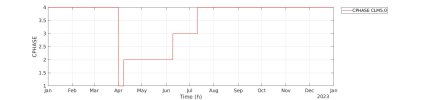
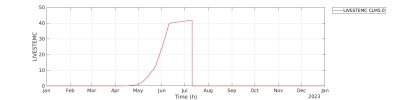
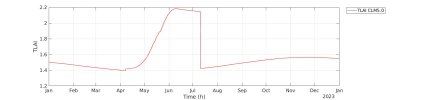
I will let @uzairrahil provide a more comprehensive answer since he has evidently done this successfully, but one thing I can think of is setting the "mergetoclmpft" variable for grapes in the parameter file appropriately. Currently, it is set to 19 and 20 (rainfed and irrigated spring wheat), so change it to 47 and 48 (rainfed and irrigated grapes) if you haven't done so already.
Thank you so much Dr.@oleson. Please correct me if I am wrong. I activated potatoes and have done the followings :
1. I cloned a fresh copy of the latest CTSM using git-fleximod update because it has the new utility called set_paramfile which is in tools .
git clone GitHub - ESCOMP/CTSM: Community Terrestrial Systems Model (includes the Community Land Model of CESM)
cd CTSM
./bin/git-fleximod update
2. Activated potatoes and irrigated potatoes as:
./set_paramfile -i input_parameter_file.nc -o output_param_file_name.nc -p potatoes,irrigated_potatoes mergetoclmpft=55,56
3. After doing the above, I got a runtime error, because pft related parameters had (nan/zero) values, for example planting_date. You will need to add some values (based on laterature initially), so then you can calibrate with observation accordingly if yield is what you are looking at.
Sincerely,
Rahil
1. I cloned a fresh copy of the latest CTSM using git-fleximod update because it has the new utility called set_paramfile which is in tools .
git clone GitHub - ESCOMP/CTSM: Community Terrestrial Systems Model (includes the Community Land Model of CESM)
cd CTSM
./bin/git-fleximod update
2. Activated potatoes and irrigated potatoes as:
./set_paramfile -i input_parameter_file.nc -o output_param_file_name.nc -p potatoes,irrigated_potatoes mergetoclmpft=55,56
3. After doing the above, I got a runtime error, because pft related parameters had (nan/zero) values, for example planting_date. You will need to add some values (based on laterature initially), so then you can calibrate with observation accordingly if yield is what you are looking at.
Sincerely,
Rahil
Thanks @uzairrahil , that seems like that is consistent with my suggestion.
@oleson Yes, the mergetoclmpft parameter value needed to be changed, and it worked. And @uzairrahil thank you for the explanation it was very helpful.
Dear @oleson ,@slevis
I had a quick question regarding my calibration setup. The hydrologic calibration was performed using lower_boundary = 2 because one of the calibrated parameters (baseflow_scalar) could not be executed properly with lower_boundary = 3. During calibration, I found that optimization was difficult and several dominant parameters exhibited contrasting sensitivities across flow regimes in Lower Michigan. In particular, the sensitivity analysis showed that highly sensitive parameters such as sucsat and hksat produced opposite effects under high-flow and low-flow conditions (e.g., positive sensitivity in one regime and negative in the other), which may explain the calibration trade-offs and difficulty in simultaneously improving both regimes.
My questions are:
I had a quick question regarding my calibration setup. The hydrologic calibration was performed using lower_boundary = 2 because one of the calibrated parameters (baseflow_scalar) could not be executed properly with lower_boundary = 3. During calibration, I found that optimization was difficult and several dominant parameters exhibited contrasting sensitivities across flow regimes in Lower Michigan. In particular, the sensitivity analysis showed that highly sensitive parameters such as sucsat and hksat produced opposite effects under high-flow and low-flow conditions (e.g., positive sensitivity in one regime and negative in the other), which may explain the calibration trade-offs and difficulty in simultaneously improving both regimes.
My questions are:
- Could significant issues arise from performing the final production simulations using lower_boundary = 3 after calibrating under lower_boundary = 2?
- Is it physically reasonable for parameters such as sucsat and hksat to influence high-flow and low-flow regimes in fundamentally different or even opposing ways?

1. I do not expect significant issues, but also I may have a different definition of significant. I see two potential problems that do not seem insurmountable, so you may be willing to try:
- First, searching for "lower_boundary" in `bld/namelist_files/namelist_definition_ctsm.xml` I see that you cannot use_groundwater_irrigation with lower_boundary_condition = 3. Maybe that's not a problem at all.
- Second, there's a possibility that the model will go through an adjustment in response to the new setting. If so, you may decide that you need to drop that part of the simulation, or whatever you think is best for your experiments.
2. I do not have recent experience with these parameters, so I will let others chime in here.
- First, searching for "lower_boundary" in `bld/namelist_files/namelist_definition_ctsm.xml` I see that you cannot use_groundwater_irrigation with lower_boundary_condition = 3. Maybe that's not a problem at all.
- Second, there's a possibility that the model will go through an adjustment in response to the new setting. If so, you may decide that you need to drop that part of the simulation, or whatever you think is best for your experiments.
2. I do not have recent experience with these parameters, so I will let others chime in here.
Dear @slevis
Thanks for the information. I have a quick question.
I am using a calibrated CLM model, including a calibrated baseflow_scalar. To ensure that baseflow_scalar is applied, I set lower_boundary_condition = 2 in user_nl_clm. However, with lower_boundary_condition = 2, the QCHARGE variable is not included in the model output.
I have two questions:
Thanks for the information. I have a quick question.
I am using a calibrated CLM model, including a calibrated baseflow_scalar. To ensure that baseflow_scalar is applied, I set lower_boundary_condition = 2 in user_nl_clm. However, with lower_boundary_condition = 2, the QCHARGE variable is not included in the model output.
I have two questions:
- Is it possible to estimate or reconstruct QCHARGE from other CLM output variables when lower_boundary_condition = 2?
- Is there any way to use the calibrated baseflow_scalar while setting lower_boundary_condition = 3, so that QCHARGE is still produced?
1. From looking at the code, I see that QCHARGE is defined as the aquifer recharge rate. Look for the mathematical definition directly in the code (variable name qcharge or qcharge_col) and maybe also in the CLM Technical Note. This should give you a better answer than I can :-)
2. It seems worth trying; however, I advise looking at how the code uses baseflow_scalar (the Technote may help), in order to get an idea of how you may accomplish this.
2. It seems worth trying; however, I advise looking at how the code uses baseflow_scalar (the Technote may help), in order to get an idea of how you may accomplish this.
Thanks dear Dr. @slevis.
I have another question. I am running future simulations using my own atmospheric forcing to project future crop yields under different climate scenarios, considering both constant and prognostic CO₂ concentrations. I just wanted to confirm whether the following approach is appropriate.
First, I spin up the model using a constant CO₂ concentration of 340 ppmv (based on NOAA data) in the year 1981. I then run the historical simulation with prognostic CO₂. For the future simulations, which begin in 2020, I plan to use the final restart file from the historical simulation as the initial condition.
For each climate model and scenario, I will then conduct two future simulations: one with CO₂ held constant at the 2020 (my historical ends) concentration (~412 ppmv) and another with prognostic CO₂ following the corresponding scenario. Does this seem like an appropriate experimental setup?
I have another question. I am running future simulations using my own atmospheric forcing to project future crop yields under different climate scenarios, considering both constant and prognostic CO₂ concentrations. I just wanted to confirm whether the following approach is appropriate.
First, I spin up the model using a constant CO₂ concentration of 340 ppmv (based on NOAA data) in the year 1981. I then run the historical simulation with prognostic CO₂. For the future simulations, which begin in 2020, I plan to use the final restart file from the historical simulation as the initial condition.
For each climate model and scenario, I will then conduct two future simulations: one with CO₂ held constant at the 2020 (my historical ends) concentration (~412 ppmv) and another with prognostic CO₂ following the corresponding scenario. Does this seem like an appropriate experimental setup?
Dr. @slevis
As a follow-up to my previous question, when I set up the historical simulation, I see CCSM_CO2_PPMV = 284.7. Since I will be using the finidat file from a spin-up simulation that was run with a constant CO₂ concentration of 340 ppmv, I was wondering why the historical case is showing 284.7 ppmv. Will this value be overridden by the prognostic/historical CO₂ forcing when the simulation starts, or do I need to modify it manually?
Sincerely,
Rahil
As a follow-up to my previous question, when I set up the historical simulation, I see CCSM_CO2_PPMV = 284.7. Since I will be using the finidat file from a spin-up simulation that was run with a constant CO₂ concentration of 340 ppmv, I was wondering why the historical case is showing 284.7 ppmv. Will this value be overridden by the prognostic/historical CO₂ forcing when the simulation starts, or do I need to modify it manually?
Sincerely,
Rahil