
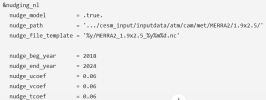
Hello, I am running CESM3_beta07 with the FCnudged_HCO compset at f19_f19_mg17 resolution. I am conducting an atmosphere simulation nudged toward MERRA2 meteorological fields. My nudging configuration is:
However, the model stops during the radiation calculation with the following error:
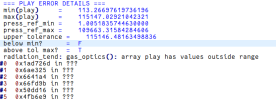
Initially, the simulation could not proceed without a pressure tolerance, so I introduced a 5% upper tolerance relative to press_ref_max. With this tolerance, the simulation ran for approximately 2.5 years before failing again. At the time of failure, max(play) slightly exceeded the upper limit, I am unsure whether it is physically and numerically appropriate to increase this tolerance further, or what effect doing so might have on the RRTMGP radiation calculation.
I also compared three nudging configurations. The free-running simulation without meteorological nudging did not encounter this error. When only the horizontal winds (U and V) were nudged, the pressure-range error occurred after only a few simulation days. When U, V, and temperature (T) were nudged together, the simulation ran for approximately 2.5 years before the same error occurred. These results suggest that the error is associated with the nudging configuration, although temperature nudging appears to delay its onset substantially.
The MERRA2 forcing data at 1.9° × 2.5° resolution were downloaded directly from the NSF NCAR GDEX dataset d313003. Since the free-running simulation does not encounter this error, I would like to understand why nudging causes play to exceed the RRTMGP pressure limit. Is increasing the pressure tolerance appropriate, and could it affect the accuracy of the radiation calculation? I would also appreciate any advice on the recommended way to address this issue. Thanks in advance!
However, the model stops during the radiation calculation with the following error:
Initially, the simulation could not proceed without a pressure tolerance, so I introduced a 5% upper tolerance relative to press_ref_max. With this tolerance, the simulation ran for approximately 2.5 years before failing again. At the time of failure, max(play) slightly exceeded the upper limit, I am unsure whether it is physically and numerically appropriate to increase this tolerance further, or what effect doing so might have on the RRTMGP radiation calculation.
I also compared three nudging configurations. The free-running simulation without meteorological nudging did not encounter this error. When only the horizontal winds (U and V) were nudged, the pressure-range error occurred after only a few simulation days. When U, V, and temperature (T) were nudged together, the simulation ran for approximately 2.5 years before the same error occurred. These results suggest that the error is associated with the nudging configuration, although temperature nudging appears to delay its onset substantially.
The MERRA2 forcing data at 1.9° × 2.5° resolution were downloaded directly from the NSF NCAR GDEX dataset d313003. Since the free-running simulation does not encounter this error, I would like to understand why nudging causes play to exceed the RRTMGP pressure limit. Is increasing the pressure tolerance appropriate, and could it affect the accuracy of the radiation calculation? I would also appreciate any advice on the recommended way to address this issue. Thanks in advance!