Describe your problem or question:
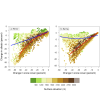
Hello, I am using the MESACLIP simulations to assess elevation-dependent warming (EDW) in the Rocky Mountains (defined by a shapefile which goes from the Colorado Rockies up to the Canadian Rockies). I am looking at EDW for a climate at a global warming level of 4°C compared to pre-industrial. My question is about the differing sensitivities of the surface albedo decline to the reduction in snow cover fraction between the low-elevation (0-1500m) and high-elevation (2200-) regions of the Rockies. The attached figure shows that for winter and spring, there is s larger decline in albedo at high elevation (red line fit) than at low elevation (blue line fit) for the same reduction in snow cover fraction. My initial and very (too?) simple explanation is that the albedo of the soil beneath the snow has a smaller value at high-elevation (rocks, bare soil) than at low-elevation (vegetation). I would like to test if this assumption is a reasonable one or not by looking at the prescribed albedo of the different soil types. I know it is probably much more complicated (snow albedo depends on many things and can be different between low and high elevations, vegetation albedo depends on leaf area etc ...). Any advice or idea to test the hypothesis or other possible explanations would be great !
Thanks, Laurent
Hello, I am using the MESACLIP simulations to assess elevation-dependent warming (EDW) in the Rocky Mountains (defined by a shapefile which goes from the Colorado Rockies up to the Canadian Rockies). I am looking at EDW for a climate at a global warming level of 4°C compared to pre-industrial. My question is about the differing sensitivities of the surface albedo decline to the reduction in snow cover fraction between the low-elevation (0-1500m) and high-elevation (2200-) regions of the Rockies. The attached figure shows that for winter and spring, there is s larger decline in albedo at high elevation (red line fit) than at low elevation (blue line fit) for the same reduction in snow cover fraction. My initial and very (too?) simple explanation is that the albedo of the soil beneath the snow has a smaller value at high-elevation (rocks, bare soil) than at low-elevation (vegetation). I would like to test if this assumption is a reasonable one or not by looking at the prescribed albedo of the different soil types. I know it is probably much more complicated (snow albedo depends on many things and can be different between low and high elevations, vegetation albedo depends on leaf area etc ...). Any advice or idea to test the hypothesis or other possible explanations would be great !
Thanks, Laurent