
Hi~
I was running an I2000CLM50CN experiment recently and had a problem with the results.
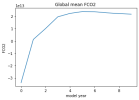
I first ran this experiment for ten years, and found that FCO2 presents a process from negative to positive. FCO2 is the value CO2 flux to atmosphere (+ to atm), so I think it is a net CO2 flux.
While soil is generally regarded as a carbon sink, so this value should be negative. Although the model may not be fully spin up, the positive trend of this value is robust, so how to understand the phenomenon that FCO2 is positive?
I was running an I2000CLM50CN experiment recently and had a problem with the results.
I first ran this experiment for ten years, and found that FCO2 presents a process from negative to positive. FCO2 is the value CO2 flux to atmosphere (+ to atm), so I think it is a net CO2 flux.
While soil is generally regarded as a carbon sink, so this value should be negative. Although the model may not be fully spin up, the positive trend of this value is robust, so how to understand the phenomenon that FCO2 is positive?