
Hi all,
I'm running CTSM transient SSP simulations and noticed a step change in global cropland area between 2023 and 2024 in the landuse.timeseries files. I'd like to know whether it is expected.
What version of the code are you using?
ctsm5.3
Have you made any changes to files in the source tree?
no
Files used (1.9x2.5):
Global cropland area, computed as AREA × LANDFRAC_PFT × PCT_CROP/100, jumps between 2023 and 2024 in SSP126/245/370/585 scenarios (figure attached):
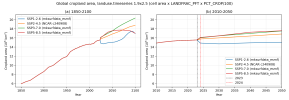
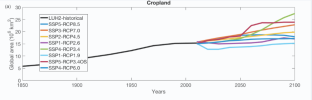
In every scenario, this is the largest year-to-year change after 2015. The original LUH2 trajectories (Hurtt et al., 2020, GMD, Fig. 4a) show no such discontinuity (figure for your reference):
What I think is happening:The file metadata shows Vegetation_type_raw_data_filename = mksrf_landuse_ctsm53_histTRENDY2024_1850.c240728.nc. In rawdata/CTSM53RawData/:
Questions:
I'm running CTSM transient SSP simulations and noticed a step change in global cropland area between 2023 and 2024 in the landuse.timeseries files. I'd like to know whether it is expected.
What version of the code are you using?
ctsm5.3
Have you made any changes to files in the source tree?
no
Files used (1.9x2.5):
- SSP2-4.5: /glade/campaign/cesm/cesmdata/inputdata/lnd/clm2/surfdata_esmf/ctsm5.3.0/landuse.timeseries_1.9x2.5_SSP2-4.5_1850-2100_78pfts_c240908.nc
- SSP1-2.6, SSP3-7.0, SSP5-8.5: generated with ctsm5.3.080/tools/mksurfdata_esmf, e.g.
./gen_mksurfdata_namelist --res 1.9x2.5 --ssp-rcp SSP5-8.5 --start-year 1850 --end-year 2100 --nosurfdata --namelist ssp585.namelist
Global cropland area, computed as AREA × LANDFRAC_PFT × PCT_CROP/100, jumps between 2023 and 2024 in SSP126/245/370/585 scenarios (figure attached):
In every scenario, this is the largest year-to-year change after 2015. The original LUH2 trajectories (Hurtt et al., 2020, GMD, Fig. 4a) show no such discontinuity (figure for your reference):
What I think is happening:The file metadata shows Vegetation_type_raw_data_filename = mksrf_landuse_ctsm53_histTRENDY2024_1850.c240728.nc. In rawdata/CTSM53RawData/:
- globalctsm53histTRENDY2024Deg025_240728/ covers 1700–2023
- globalctsm53TRSSP{119,126,245,370,460,585}Deg025_240728/ cover 2015–2100
Questions:
- Is this discontinuity known or expected?
- Were the TRSSP* raw files harmonized to TRENDY2024 at any point? If not, is a harmonized version planned (e.g., for CTSM5.4 / CMIP7)?
- For SSP studies, would you recommend the CMIP6 files (c190214, LUH2 v2h + SSP throughout) instead, or some other way to handle the transition?
